TCF Canada preparation, 2026 format
Candidate taking the TCF Canada Speaking test with an examiner
TCF Canada · Test 4

TCF Canada Speaking

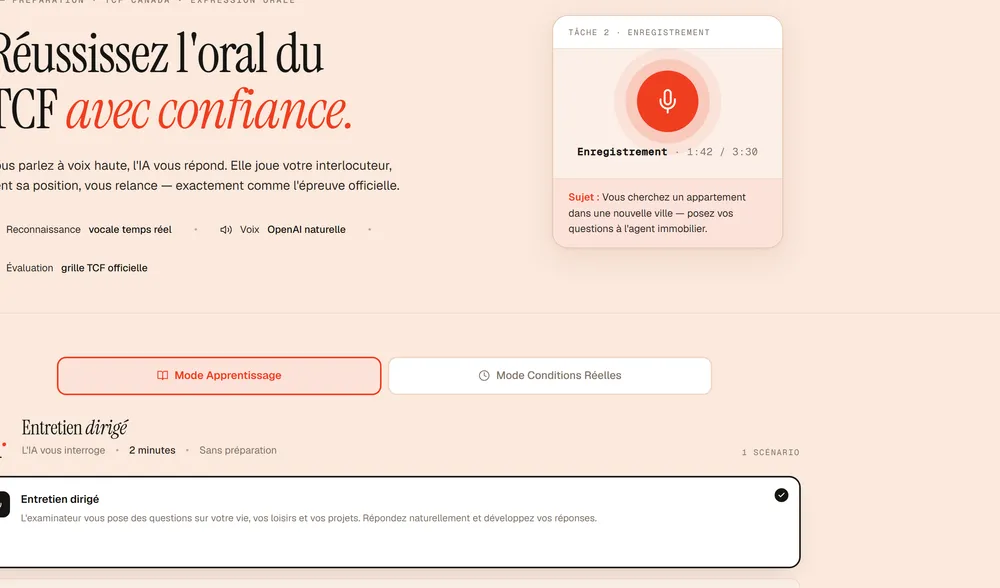
Introduce yourself, get information and defend a point of view. An AI marker plays the examiner, scores out of 20 and converts to NCLC.

In short: The TCF Canada Speaking test lasts 12 minutes with an examiner: task 1 (2 minutes, no preparation), task 2 (5 min 30, including 2 minutes of preparation) and task 3 (4 min 30, no preparation). It is scored out of 20, then converted to an NCLC level.Updated

3 tasks 12 minutes 1 examiner
In short

The TCF Canada Speaking test is an interview of about 12 minutes with an examiner, made up of 3 tasks (guided interview, interaction, expressing a point of view), scored out of 20 then converted to NCLC. On TCFCAD, an AI marker plays the examiner and assesses you on the official criteria.

01 · The 3 tasks to master

The speaking test, broken down.

12 minutes, 3 tasks, with an examiner. Here is exactly what to expect and how to perform.

01 2 min · no preparation

Guided interview

Simple questions · daily life

The examiner asks simple questions about your life, your tastes and your plans. Goal: show that you can talk with someone you don't know.

  • Answer clearly and without excessive hesitation
  • Expand your answers a little (don't answer in one word)
  • Register everyday and natural
Example question
« Pouvez-vous vous présenter ? Quel est votre film préféré ? Comment imaginez-vous votre vie dans 30 ans ? »
02 5 min 30 · 2 min prep

Interaction with preparation

Questions to ask · you lead

You ask the examiner questions about an everyday topic. You have 2 minutes to prepare your list of questions before the exchange.

  • Prepare at least 6 varied questions in 5 min
  • Cover different aspects of the topic (what, who, how, why)
  • Follow up on the answers with follow-up questions
Example situation
« Vous recherchez quelqu'un pour garder votre animal. Posez les questions pour décider si ce candidat convient. »
03 4 min 30 · no preparation

Expressing a point of view

Argument · opinion · debate

You develop your opinion spontaneously on a current topic. This task assesses your ability to argue and defend a position in a structured way.

  • Introduction: rephrase the topic and state your position
  • 2 to 3 arguments backed by concrete examples
  • Conclusion: sum up and confirm your view
Example topic
« Voyager nous rend heureux. Êtes-vous d'accord ? Les moyens de communication se développent: communique-t-on mieux aujourd'hui ? »
02 · Everything you need

Three resources, one method.

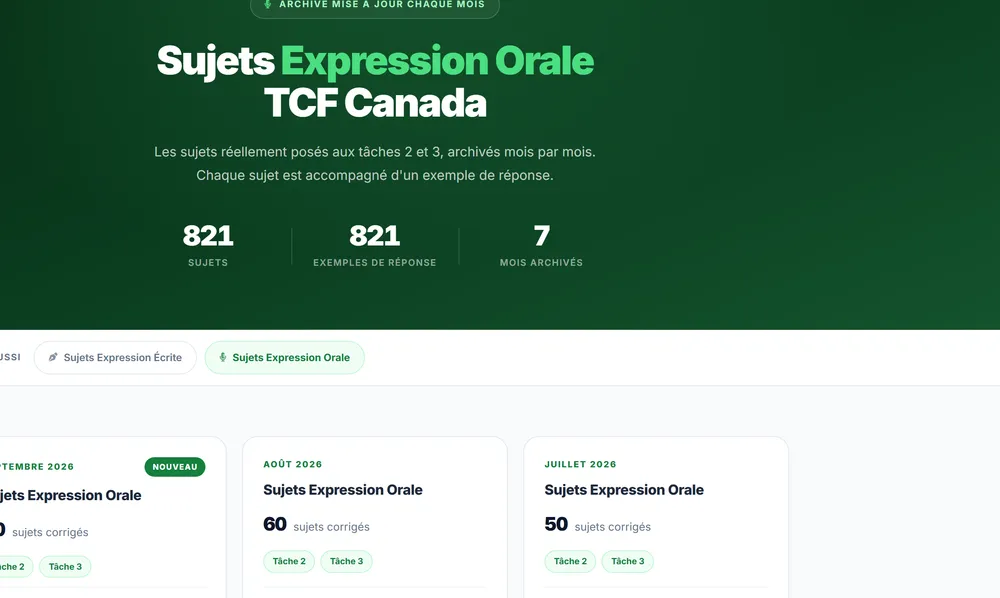
Corrected topics to practise on real themes, an AI marker to measure your progress, key phrases so you're never lost for words.

Preview of the monthly archive of corrected Speaking topics
Model answers

Corrected recent topics

Model answers for the 3 tasks, annotated against the official NCLC criteria, on recent and frequent topics.

  • Topics renewed every month
  • Notes by assessment criterion
  • B2 and C1 levels explained
See the topics
Preview of the Templates and key phrases module for Speaking
Templates

Templates & Key phrases

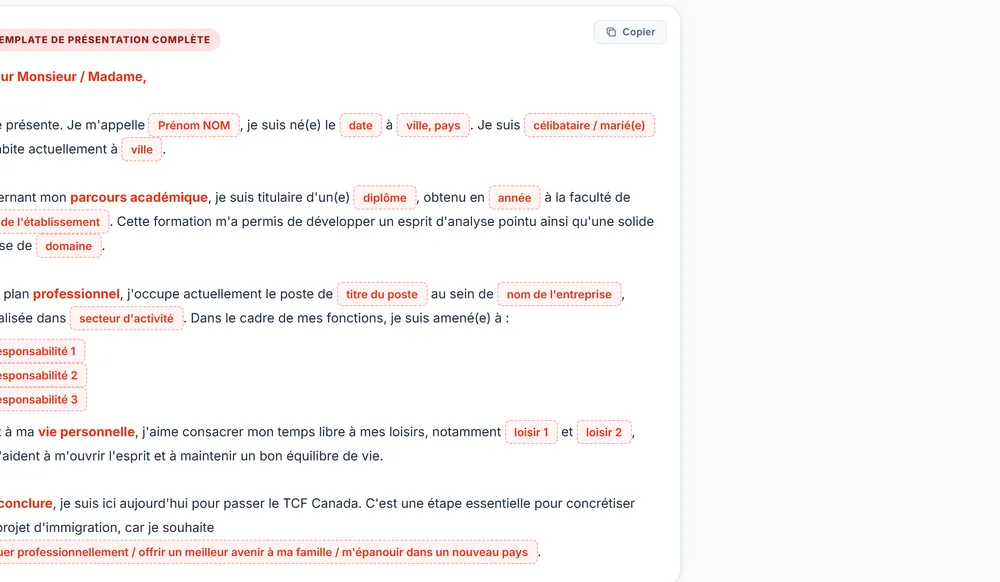
Ready-made structures to organize your task 3 answer, transition expressions and phrases for task 2.

  • Structures for the 3 tasks
  • 100+ linking expressions
  • Phrases to agree / disagree
See the templates
03 · What is assessed

The 3 competences behind your score.

Your interview is recorded and marked twice. Our AI marker builds on these competences, with a scoring grid out of 20 for each task.

Competence 01

Linguistic competence

Richness and precision of vocabulary, grammatical accuracy, fluency, pronunciation.

Vocabulary Grammar Pronunciation
Competence 02

Pragmatic competence

Ability to interact, coherence of speech, organisation of ideas, flow.

Interaction Structure Coherence
Competence 03

Sociolinguistic competence

Fit with the communication situation, appropriate register, suitable level of language.

Register Appropriateness Naturalness

These 3 competences come from the Common European Framework of Reference (CEFR), which the TCF is aligned with. The test is marked out of 20 by the examiner, then by a second marker at France Éducation international from the recording.

04 · Do / don't

The habits that make the difference.

What markers notice straight away in NCLC 9 answers, and the mistakes that lose points in every task.

DO

Winning habits.

  • Expand each answer in task 1 with an example or an explanation.
  • Prepare 6+ questions in task 2, not just yes/no ones.
  • State your plan in task 3 before arguing (« Je vais défendre l'idée que… »).
  • Use varied linking words to connect ideas (d'une part, cependant, ainsi…).
  • Correct yourself naturally when you make a mistake, without stopping for too long.
DON'T

Costly mistakes.

  • Answering in a single word in task 1: it's the easiest task to improve.
  • Asking only closed questions in task 2 (yes/no). Mix in « comment », « pourquoi ».
  • Speaking without structure in task 3: jumping between ideas at random drags the score down.
  • Always using the same words: lexical range is a criterion in its own right.
  • Going silent or freezing: it's better to rephrase or ask again than to stay silent.
05 · Toolbox

Phrases to know by heart.

Ready-made French expressions for every situation. Learn them before the exam to speak fluently and naturally.

Giving your opinion
À mon avisSelon moiJe pense queIl me semble quePour ma part
Introducing an argument
D'une partPremièrementTout d'abordEn premier lieuPar ailleurs
Qualifying / contrasting
CependantToutefoisEn revancheNéanmoinsD'un autre côté
To conclude
En conclusionPour résumerEn sommeFinalementEn définitive
Task 2 questions
Pourriez-vous me dire…Comment fonctionne…Qu'est-ce qui…Y a-t-il…
Buying time
C'est une bonne questionVoyons…Je dirais queEn faitDisons que
Illustrating
Par exempleNotammentEn effetPrenons le cas deÀ titre d'exemple
Rephrasing
Autrement ditC'est-à-direEn d'autres termesJe veux direPlus précisément
Frequently asked questions

TCF Canada Speaking: your questions

How does the TCF Canada Speaking test work?

The TCF Canada Speaking test lasts about 12 minutes and has 3 tasks with an examiner: task 1 (guided interview: introduce yourself and answer questions), task 2 (interaction: get information on a given topic) and task 3 (expressing and arguing a point of view on a set topic). Each task is harder than the last.

What criteria is the TCF Canada Speaking test scored on?

Speaking is assessed on the ability to communicate and interact, ease and fluency, range and control of vocabulary, grammatical accuracy and pronunciation. TCFCAD's AI marker analyses your speaking against these official criteria and places you on the NCLC scale.

Does TCFCAD mark speaking?

Yes. TCFCAD offers an AI Speaking marker that instantly assesses your answers to the 3 tasks, with corrected topics, key phrases and a detailed method for each task. You get immediate feedback and advice to reach NCLC 9.

How do I succeed in task 3 of the TCF Canada Speaking test?

Task 3 asks you to express and defend a point of view on a set topic, with no preparation time. To succeed: state your position clearly, structure your argument with 2 or 3 points backed by examples, use linking words and conclude. TCFCAD provides corrected topics and key phrases specific to task 3 so you can practise effectively.

How can I practise TCF Canada speaking without a partner?

TCFCAD's AI speaking marker lets you practise alone, at any time: you answer topics for the 3 tasks and get an instant assessment on the official criteria, just like with an examiner. You can repeat as often as you need to build confidence before exam day.

Your next session starts now.

Speak your first answer. Get your score.

Speaking Series 1 is free. You answer a real topic, and the AI marks it criterion by criterion in under 15 seconds.

✓ No credit card ✓ AI marking in 15 s ✓ Key phrases included
WhatsApp
Chat on WhatsApp
Passer en françaisFrançais Switch to EnglishEnglish