1. What is the TEF Canada?
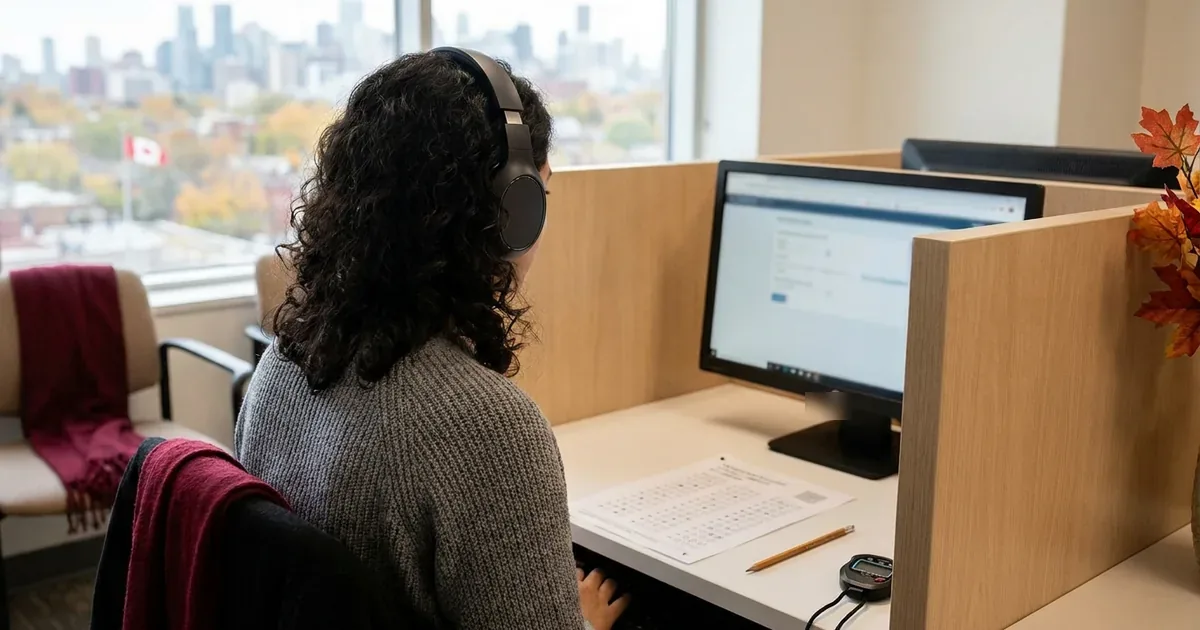
The TEF Canada (Test d'évaluation de français) measures the French of people applying to immigrate to Canada or to become citizens. It is run by Le français des affaires, part of the Paris Île-de-France Chamber of Commerce (CCI Paris Île-de-France), and IRCC has recognised it since 2002. Le français des affaires says the test is offered in about 500 official centres in more than 110 countries.
Which sections you take depends on your goal:
- Permanent residence (Express Entry, provincial nominee programs): all 4 sections are required.
- Citizenship: 2 sections only, listening and speaking. IRCC asks for CLB 4 in both.
- Francophone mobility (work permit): Le français des affaires indicates CLB 5.
IRCC writes French levels as NCLC (Niveaux de compétence linguistique canadiens). NCLC is simply the French name of the CLB scale: NCLC 7 and CLB 7 are the same level. Our guide to CLB levels in French explains the scale.
Source: Le français des affaires, TEF Canada page, checked November 26, 2026.
2. TEF Canada format: the 4 sections
The 4 sections last 2 hours 55 minutes in total, not counting breaks, and Le français des affaires requires them to be taken on the same day for the certificate to be valid for Canadian authorities.
| Section | Time | What you do |
|---|---|---|
| Reading (compréhension écrite) | 60 min | 40 multiple-choice questions |
| Listening (compréhension orale) | 40 min | 40 multiple-choice questions |
| Writing (expression écrite) | 60 min | Section A (25 min): continue a news article, at least 80 words. Section B (35 min): give and defend your opinion, at least 200 words |
| Speaking (expression orale) | 15 min | Section A (5 min): ask questions to get information. Section B (10 min): argue to convince the examiner |
In reading and listening, each correct answer earns one point and a wrong or blank answer costs nothing. Never leave a question unanswered.
3. The score out of 699 and the "old score": the Express Entry trap
Since December 11, 2023, the TEF Canada certificate gives a score from 0 to 699 for each section, with a CEFR level and an NCLC level. It also has a second column called "Équivalence ancien score" (old score equivalence).
For Express Entry, IRCC is explicit: enter the scores from the "Équivalence ancien score" column in your profile, whatever the date of your test, and never the score out of 699. A wrong entry can give you the wrong CLB level, and IRCC warns that it may then refuse your application.
Sources: Express Entry language testing (IRCC) and TEF Canada results (Le français des affaires).
4. TEF Canada to CLB score chart
For Express Entry, use this table ("Équivalence ancien score" column):
| CLB / NCLC | Listening | Reading | Writing | Speaking |
|---|---|---|---|---|
| 10 | 316-360 | 263-300 | 393-450 | 393-450 |
| 9 | 298-315 | 248-262 | 371-392 | 371-392 |
| 8 | 280-297 | 233-247 | 349-370 | 349-370 |
| 7 | 249-279 | 207-232 | 310-348 | 310-348 |
| 6 | 217-248 | 181-206 | 271-309 | 271-309 |
| 5 | 181-216 | 151-180 | 226-270 | 226-270 |
| 4 | 145-180 | 121-150 | 181-225 | 181-225 |
Score out of 699, for tests taken from December 11, 2023 (table published by IRCC for the programs that use it):
| CLB / NCLC | Listening | Reading | Writing | Speaking |
|---|---|---|---|---|
| 10 | 546-699 | 546-699 | 558-699 | 556-699 |
| 9 | 503-545 | 503-545 | 512-557 | 518-555 |
| 8 | 462-502 | 462-502 | 472-511 | 494-517 |
| 7 | 434-461 | 434-461 | 428-471 | 456-493 |
| 6 | 393-433 | 393-433 | 379-427 | 422-455 |
| 5 | 352-392 | 352-392 | 330-378 | 387-421 |
| 4 | 306-351 | 306-351 | 268-329 | 328-386 |
CLB 7 in all four abilities is the minimum for the Federal Skilled Worker program. Our guide to the minimum French score for Express Entry shows the CRS points each CLB level earns.
Sources: Express Entry score table (IRCC) and IRCC table for tests taken from December 11, 2023. If in doubt, the IRCC page prevails.
5. TEF Canada fees and booking in Canada
Each centre sets its own price. Le français des affaires states that fees vary by centre and by the number of sections taken. Here is what four Canadian centres published on November 26, 2026:
| Centre | Fee | Rules | Results |
|---|---|---|---|
| Alliance française de Toronto | CAD $390 (4 sections) | No refund. Transfer possible up to 15 days before the exam, for a $100 fee. In person only, US QWERTY keyboard | Certificate by email within 1 to 15 days |
| Alliance française d'Edmonton | CAD $390 (4 sections); $195 listening and speaking | No transfer to another person. Writing, listening and reading on computer. All December 2026 sessions shown as sold out | By email 1 to 2 weeks after the exam |
| McGill University (Montréal) | Per section: $145 listening, $145 speaking, $73 reading, $73 writing | Non-refundable, no date change. In person only | About 15 days after the test |
| Memorial University (St. John's) | CAD $460 | Non-refundable. Residents of Newfoundland and Labrador only. New sessions from February 2027, registration link in December 2026 | Not stated |
How to book: find a centre with the "find a test centre" tool of Le français des affaires, then register directly with that centre. Registration is firm: Le français des affaires keeps the fees if you withdraw or do not show up. Leave at least 20 days between two sittings of the same section, as the Alliance française de Toronto and McGill require.
Since November 10, 2026, the Alliance française d'Edmonton says TEF re-evaluations (re-marking) are no longer available until further notice. Check with your centre before counting on one.
Sources: pages of the Alliance française de Toronto, Alliance française d'Edmonton, McGill School of Continuing Studies and Memorial University, checked November 26, 2026. Prices and dates change often: confirm on the centre's page before paying.
6. How long are TEF Canada results valid?
Two years. Le français des affaires counts the 2 years from the date the certificate is issued. IRCC needs results less than 2 years old both when you create your Express Entry profile and when you submit your application for permanent residence, so plan your test date around both steps.
7. TEF Canada or TEFaQ?
The TEFaQ (Test d'évaluation du français adapté au Québec) is another version of the test, built for Quebec immigration. The difference that matters:
| TEF Canada | TEFaQ | |
|---|---|---|
| Accepted by IRCC (federal) | Yes | No |
| Accepted by Quebec (MIFI) | Yes | Yes |
| Sections | 4 required for federal immigration | Modular: you take the sections your Quebec file requires |
If your plan involves both Quebec and a federal program such as Express Entry or citizenship, the TEF Canada covers both. The TEFaQ is for Quebec only. Check with the MIFI which sections your Quebec program requires.
8. TEF Canada or TCF Canada?
IRCC accepts both and converts them to the same CLB scale, so neither is officially easier. The real differences are in the format:
| TEF Canada | TCF Canada | |
|---|---|---|
| Run by | CCI Paris Île-de-France | France Éducation international |
| Listening | 40 questions, 40 min | 39 questions, 35 min |
| Reading | 40 questions, 60 min | 39 questions, 60 min |
| Writing | 2 sections, 60 min | 3 tasks, 60 min |
| Speaking | 2 sections, 15 min | 3 tasks, 12 min |
| Score you enter in Express Entry | "Old score" column | Score out of 699 (listening, reading) and out of 20 (writing, speaking) |
Pick the format that suits you and the test with dates near you. Our TEF vs TCF Canada comparison goes through difficulty, cost and retakes in detail.
9. How to prepare for the TEF Canada
- Know your target in the right scale. Find the "old score" for your target CLB in the first table above (for example 249 in listening for CLB 7). That is the number that counts for Express Entry.
- Answer every question. A wrong answer costs nothing in reading and listening, so never leave a blank.
- Train at the real pace. 40 listening questions in 40 minutes and 40 reading questions in 60 minutes: do your practice timed.
- Prepare both writing sections. Section A: continue an article in 25 minutes (80 words minimum). Section B: defend an opinion in 35 minutes (200 words minimum). Keep a few minutes to proofread.
- Practise speaking as a conversation. In section A (5 min) you ask questions to get information; in section B (10 min) you must convince the examiner. Practise aloud with someone who pushes back.
The core skills are the same as for the TCF Canada: fast listening, reading documents, and arguing in writing and aloud. Our practice series follow the TCF Canada format, not the exact TEF format, but they train those skills. For speaking, a mock speaking exam with a teacher lets you practise arguing with a real examiner.


