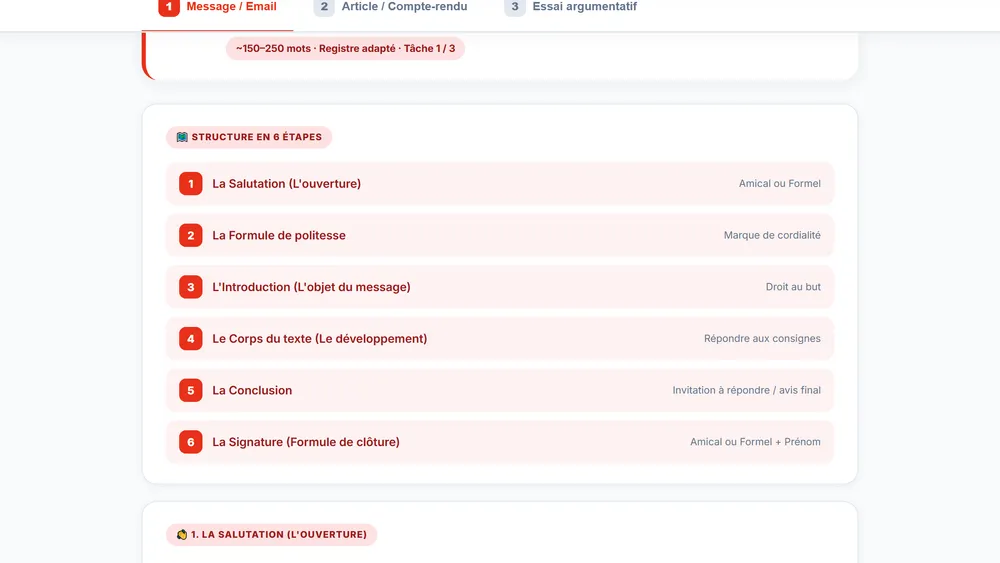
Short message
You write a message to describe, recount or explain a situation to a specific recipient.
- Register formal or semi-formal depending on context
- Strict adherence to the prompt (recipient, purpose)
- Appropriate opening and closing formulas
Ready-to-use templates for the 3 tasks, a timed simulator and AI feedback on the 6 criteria of the official scoring scale. Aim for C1, secure your NCLC 9.
60 minutes, 3 tasks, a precise scoring scale. Here is what the examiner expects at each step.
You write a message to describe, recount or explain a situation to a specific recipient.
You develop your personal opinion on a given topic, providing arguments and examples.
You summarize two opposing viewpoints, then defend your own with arguments.
Templates so you never start from a blank page, a simulator to practice under real conditions, AI to grade every attempt.
Complete structures for the 3 tasks, with ready-made phrasings, connectors and placeholders to fill in.
Access the templatesYou write a task, the clock ticks, the AI grades in 15s on the 6 official TCF criteria.
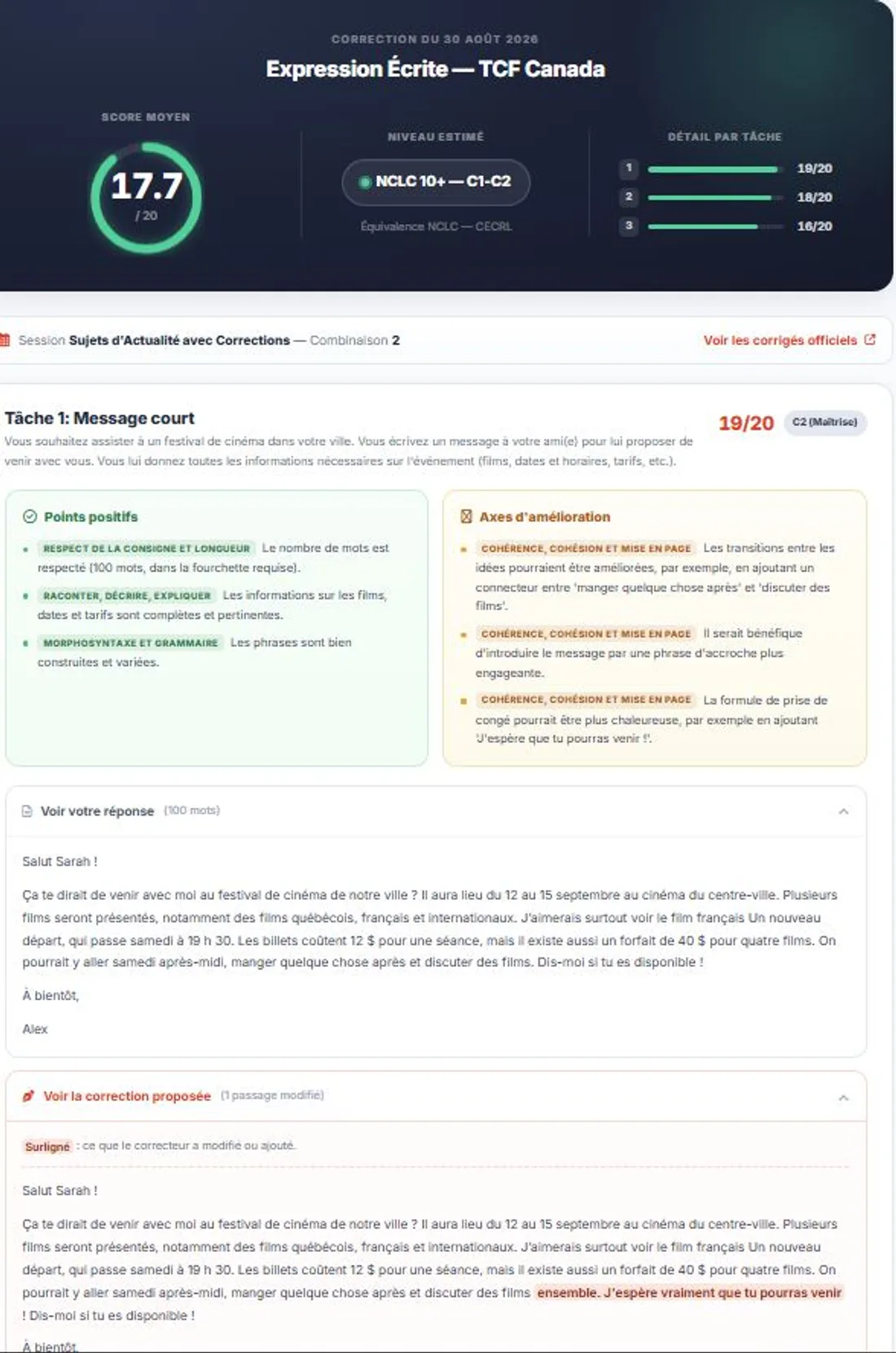
Launch the simulatorModel answers graded /20, annotated line by line, on recent themes.
See the model answersThis is exactly what the examiner checks off. Our AI corrections reproduce this scale identically.
Recipient, register, length, purpose — everything requested must be there.
Adapting to the recipient, suitable register, opening and closing formulas.
Clear structure, paragraphs, logical connectors, natural flow of ideas.
Range and precision of vocabulary, variety, accuracy of terms.
Conjugation, agreement, sentence structure, overall grammatical command.
Lexical and grammatical spelling, punctuation, accents.
What our graders spot first in NCLC 9 papers — and the mistakes that sink NCLC 6 papers.
Learn 3 per category. Use them from Task 2 on to boost cohesion. (French connectors — learn them as-is.)
Series 1 of Written Expression is free. You write a real topic, the AI grades you on the 6 official criteria in under 15 seconds.