Home / The 4 tests / Oral expression
Test 4 · 12 min · 3 tasks · graded /20

Master the TCF Canada
Oral Expression.

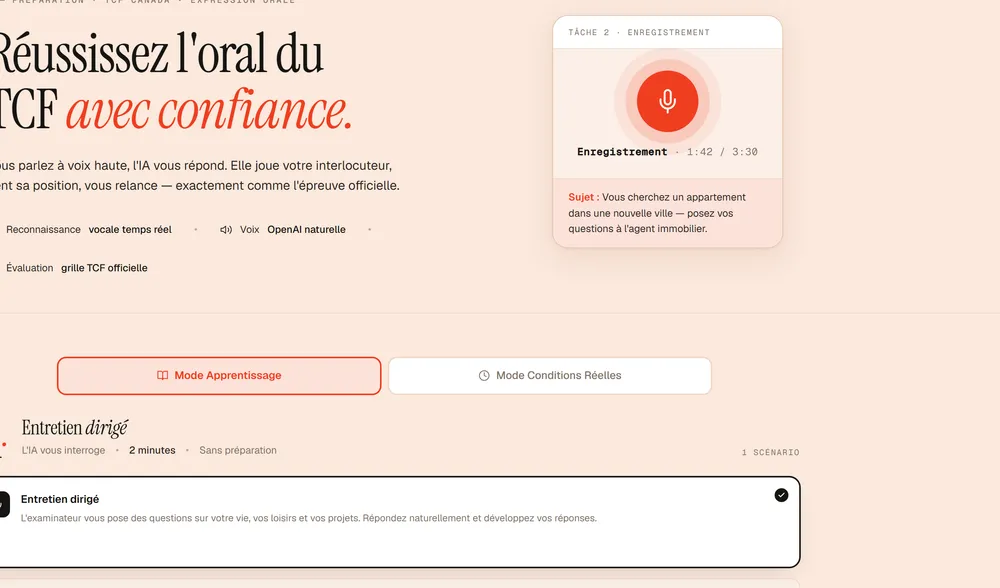
The complete method for the 3 tasks, an instant AI grader and corrected current-affairs topics based on the official criteria. Face the speaking test with confidence, aim for NCLC 9.

12 minTotal duration
3 tasksInterview, interaction, opinion
5 minTask 2 preparation
3 criteriaLinguistic, pragmatic, sociolinguistic
/20Graded out of 20
NCLC 9C1 threshold within reach
  • AI feedback in 15 s
  • Official topics
  • Key phrases included
Candidate taking the TCF Canada Oral Expression test with an examiner
01 — The 3 tasks to master

The oral expression test, broken down.

12 minutes, 3 tasks, with an examiner. Here is exactly what awaits you and how to perform.

01 2 min · no preparation

Guided interview

Simple questions · everyday life

The examiner asks simple questions about your life, tastes and plans. Goal: show that you can converse with someone you don't know.

  • Answer clearly and without excessive hesitation
  • Expand slightly on your answers (don't answer in one word)
  • Register everyday and natural
Sample question
"Can you introduce yourself? What is your favorite film? How do you picture your life in 30 years?"
02 5 min 30 · 5 min prep

Interaction with preparation

Questions to ask · you lead

You ask the examiner questions about an everyday topic. You have 5 minutes to prepare your list of questions before the exchange.

  • Prepare at least 6 varied questions in 5 min
  • Cover different aspects of the topic (what, who, how, why)
  • Follow up on the answers with follow-up questions
Sample situation
"You are looking for someone to look after your pet. Ask the questions to decide whether this candidate is suitable."
03 4 min 30 · no preparation

Expressing a viewpoint

Argumentation · opinion · debate

You spontaneously develop your opinion on a current topic. This task assesses your ability to argue and defend a position in a structured way.

  • Introduction: restate the topic and state your position
  • 2 to 3 arguments illustrated with concrete examples
  • Conclusion: summarize and confirm your opinion
Sample topic
"Traveling makes us happy. Do you agree? Communication tools are developing — do we communicate better today?"
02 — Everything you need

Three resources, one method.

Corrected topics to practice on real themes, an AI grader to measure your progress, key phrases so you're never lost for words.

Resource 01

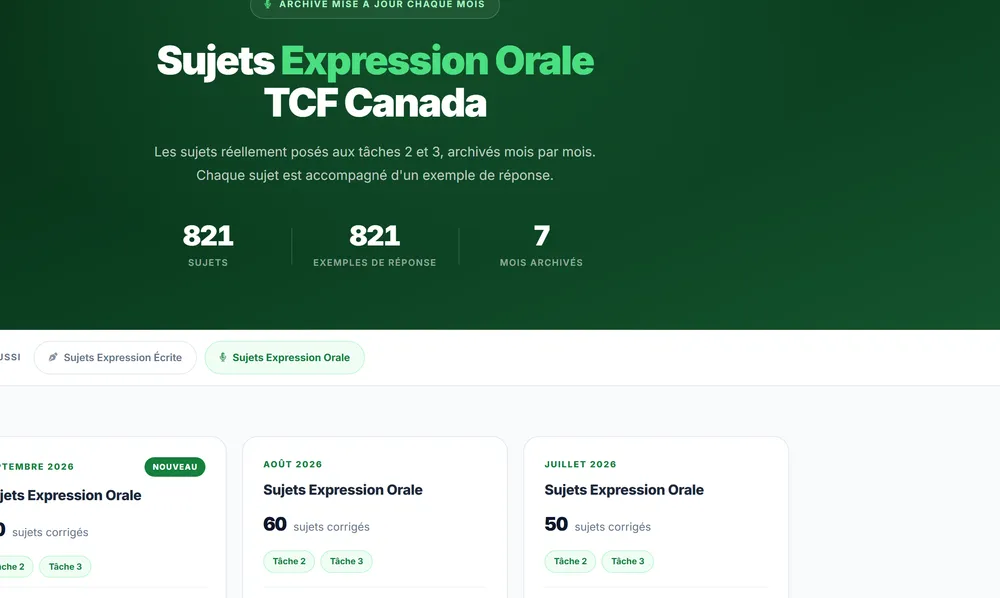
Corrected current-affairs topics

Model answer examples for the 3 tasks, annotated against the official NCLC criteria, on recent and frequent themes.

  • Topics refreshed every month
  • Annotations per assessment criterion
  • B2 and C1 levels annotated
See the topics
Resource 03

Templates & Key phrases

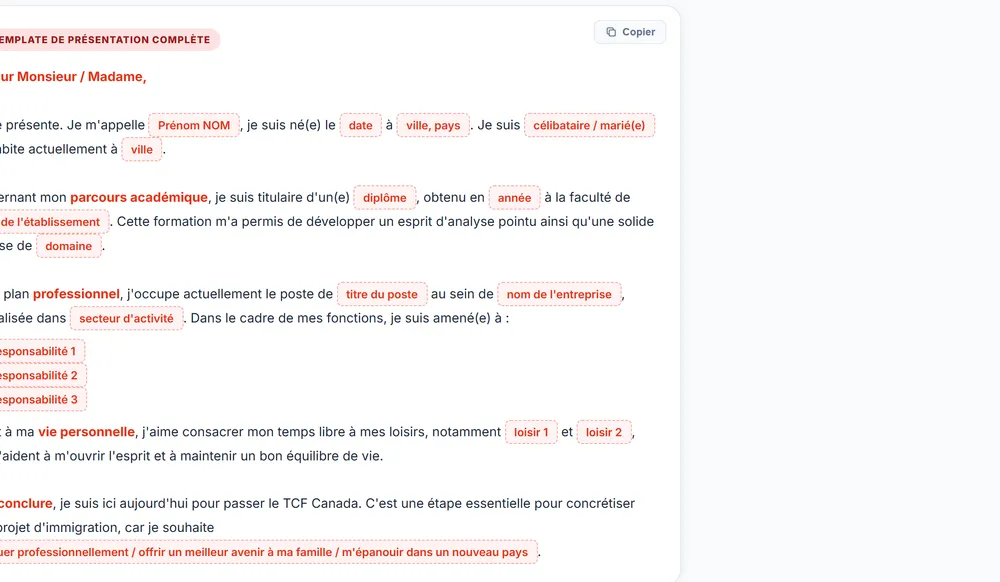
Ready-made structures to organize your task 3 answer, transition expressions and formulas for task 2.

  • Structures for the 3 tasks
  • 100+ linking expressions
  • Phrases to express agreement / disagreement
See the templates
03 — The official scale

On 3 criteria, no more.

This is exactly what two independent graders listen for in your recording. Our AI reproduces this scale identically.

Criterion 01

Linguistic competence

Range and precision of vocabulary, grammatical accuracy, fluency, pronunciation.

Vocabulary Grammar Pronunciation
Criterion 02

Pragmatic competence

Ability to interact, coherence of speech, structuring of ideas, flow.

Interaction Structure Coherence
Criterion 03

Sociolinguistic competence

Suitability to the communication situation, appropriate register, adapted language level.

Register Suitability Naturalness
04 — Do / don't

The habits that make the difference.

What graders notice immediately in NCLC 9 performances — and the mistakes that lose points on every task.

DO

The winning habits.

  • Expand each answer in task 1 with an example or explanation.
  • Prepare 6+ questions in task 2 — not just yes/no.
  • State your plan in task 3 before arguing ("I will defend the idea that…").
  • Use varied connectors to link ideas (d'une part, cependant, ainsi…).
  • Self-correct naturally if you make a mistake, without stopping too long.
DON'T

The costly mistakes.

  • Answering in a single word in task 1 — it's the easiest task to improve.
  • Asking only closed questions in task 2 (yes/no). Vary with "how", "why".
  • Speaking without structure in task 3 — stringing ideas at random drops the score.
  • Always using the same words — lexical range is a criterion in its own right.
  • Going silent or freezing — better to rephrase or ask again than to stay silent.
05 — Toolbox

The phrases to know by heart.

Ready-made expressions for every situation. Learn them before the exam to speak fluently and naturally. (French phrases — memorize them as-is.)

Giving your opinion
À mon avisSelon moiJe pense queIl me semble quePour ma part
Introducing an argument
D'une partPremièrementTout d'abordEn premier lieuPar ailleurs
Qualifying / contrasting
CependantToutefoisEn revancheNéanmoinsD'un autre côté
Concluding
En conclusionPour résumerEn sommeFinalementEn définitive
Task 2 questions
Pourriez-vous me dire…Comment fonctionne…Qu'est-ce qui…Y a-t-il…
Buying time
C'est une bonne questionVoyons…Je dirais queEn faitDisons que
Illustrating
Par exempleNotammentEn effetPrenons le cas deÀ titre d'exemple
Rephrasing
Autrement ditC'est-à-direEn d'autres termesJe veux direPlus précisément
Your next session starts now.

Speak your first answer. Get your score.

Series 1 of Oral Expression is free. You answer a real topic, the AI grades on the 3 official criteria in under 15 seconds.

✓ No credit card ✓ AI feedback in 15s ✓ Key phrases included
WhatsApp
Chat on WhatsApp
FRFrançais ENEnglish